User Retention of Mobile Augmented Reality for Cultural Heritage Learning
Abstract:
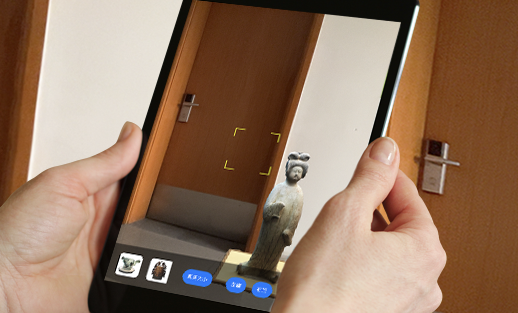
Mobile Augmented Reality (AR) is becoming increasingly afford-able and popular with the constantly improving computing power of mobile devices and the popularity of smartphones and tablets. In this paper, we present a user study that investigates user retention of mobile AR in cultural heritage learning. We developed a mobile AR application that allows users to observe 3D models of museum arti-facts and learn about their culture and history. Participants achieved a knowledge retention rate of 78.21%, indicating the positive effects of mobile AR on cultural heritage learning. We performed a structural equation modeling analysis (N=50) to investigate the effects of usability, satisfaction, emotional attachment, focus of attention, and flow experience on user retention of mobile AR. The analysis results confirmed that user satisfaction and flow experience positively affect user retention. Usability and focus of attention contribute positively to user satisfaction and flow experience respectively.
Main reference:
N. Xu, Y. Li, J. Lin, L. Yu and H. -N. Liang, "User Retention of Mobile Augmented Reality for Cultural Heritage Learning," 2022 IEEE International Symposium on Mixed and Augmented Reality Adjunct (ISMAR-Adjunct), Singapore, Singapore, 2022, pp. 447-452, doi: 10.1109/ISMAR-Adjunct57072.2022.00095.
BibTeX:
@INPROCEEDINGS{9974472,
  author={Xu, Ningning and Li, Yue and Lin, Jie and Yu, Lingyun and Liang, Hai-Ning},
  booktitle={2022 IEEE International Symposium on Mixed and Augmented Reality Adjunct (ISMAR-Adjunct)},
  title={User Retention of Mobile Augmented Reality for Cultural Heritage Learning},
  year={2022},
  volume={},
  number={},
  pages={447-452},
  keywords={Visualization;Solid modeling;Three-dimensional displays;Mathematical models;Museums;Cultural differences;History;augmented reality;mobile AR;user retention;cultural heritage;learning;Human-centered computing;Human computer interaction (HCI);Interaction paradigms;Mixed/augmented reality},
  doi={10.1109/ISMAR-Adjunct57072.2022.00095}}