Understanding the Effect of Latency on User Performance of Target Selection in Virtual Reality
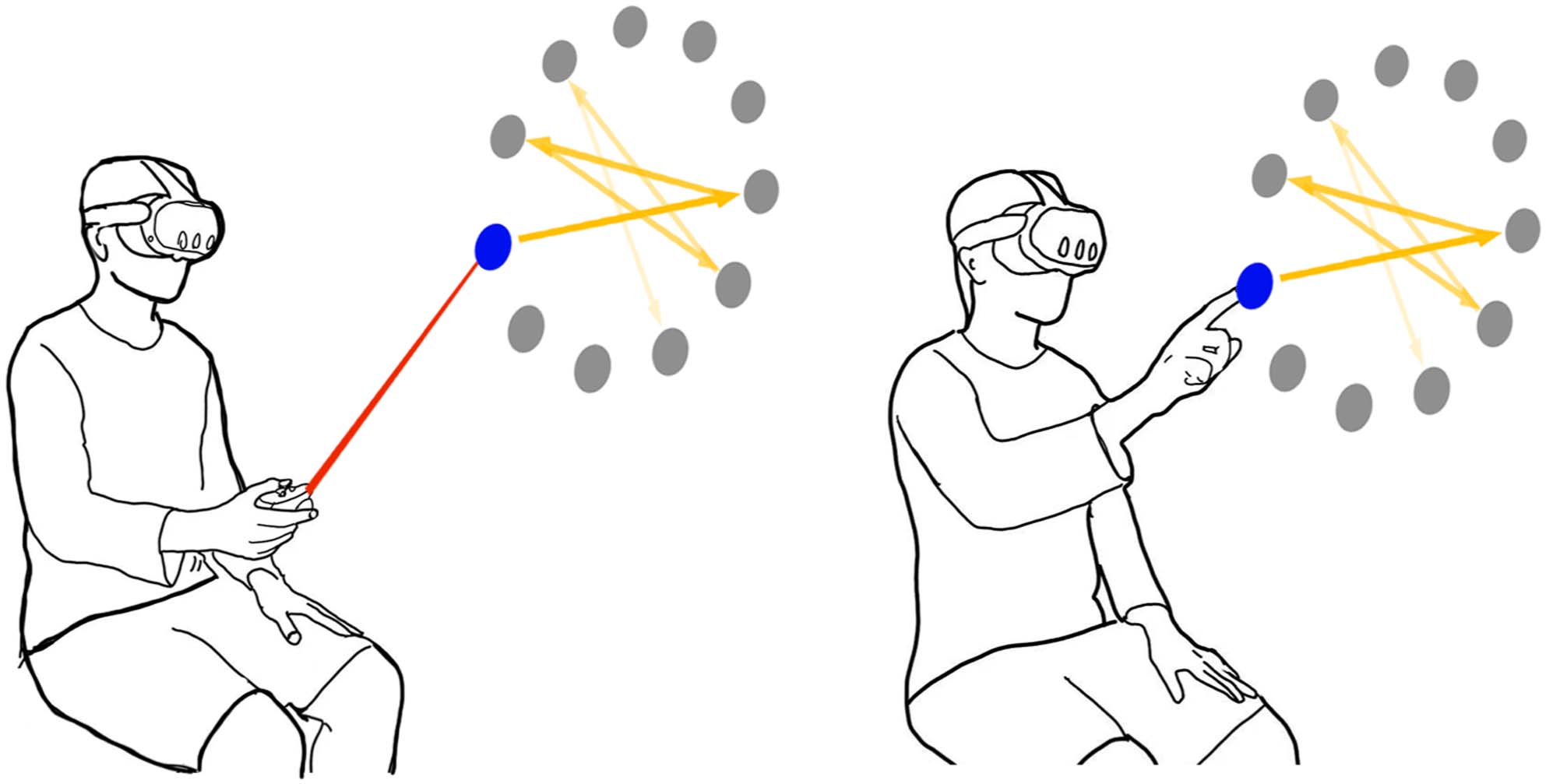
Abstract:
High latency is often introduced due to limited computational capabilities and high hardware demands. It has proven to significantly impair user performance in target selection, a fundamental interaction task. Existing research has established that latency negatively impacts selection times and success rates in 2D interactive systems; however, the underlying behavioral mechanisms remain unclear. This article investigates the effects of latency on selection times, success rates, and endpoint distributions in Virtual Reality (VR) with controller-based raycasting and bare-hand direct touch—the two most common selection methods. Our results from a user study (N = 31) revealed distinct patterns between the two methods, leading to two novel mathematical models that account for latency, target width, and movement amplitude. These two models were validated via a new dataset collected from a second user study (N = 16) and were demonstrated to outperform the existing models. Our findings provide actionable recommendations to mitigate the negative impacts of latency and improve user experience in VR interface design.
Main reference:
Y. Wei et al., "Understanding the Effect of Latency on User Performance of Target Selection in Virtual Reality," in IEEE Transactions on Visualization and Computer Graphics, vol. 32, no. 2, pp. 2200-2215, Feb. 2026, doi: 10.1109/TVCG.2025.3634367.
BibTeX:
@ARTICLE{Wei:2026:UEL,
  author={Wei, Yushi and Shi, Rongkai and Xu, Kemu and Wang, Jialin and Gao, BoYu and Hui, Pan and Yu, Lingyun and Liang, Hai-Ning},
  journal={IEEE Transactions on Visualization and Computer Graphics},
  title={Understanding the Effect of Latency on User Performance of Target Selection in Virtual Reality},
  year={2026},
  volume={32},
  number={2},
  pages={2200-2215},
  doi={10.1109/TVCG.2025.3634367}}