L-WiM: Collaborative Exploration in Immersive Environments
Abstract:
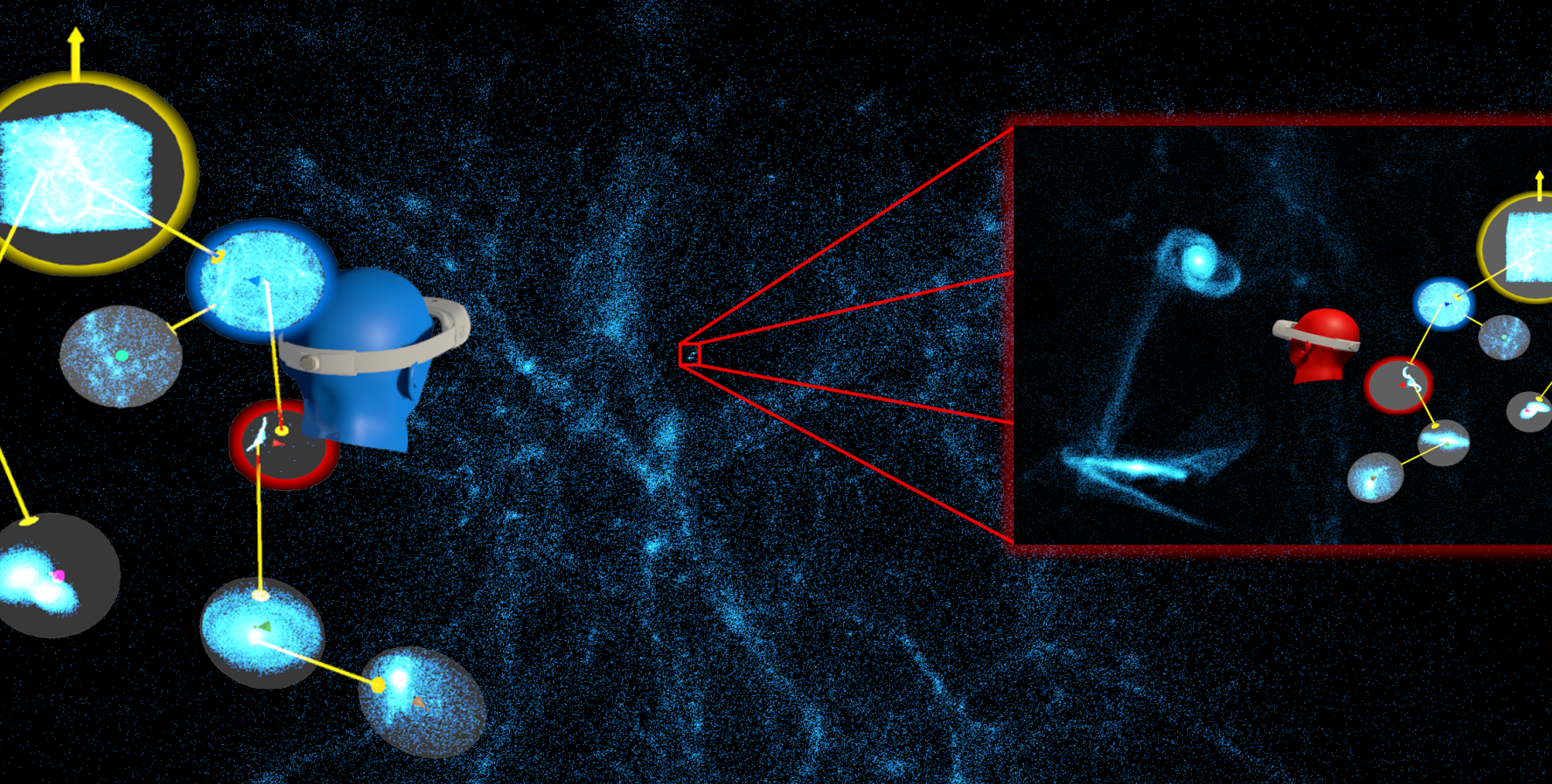
An immersive environment provides multiple users a shared space for collaborative data explorations through head-mounted displays (HMDs). Effective collaboration is built based on different strategies, including the ability to focus on one's own tasks, be aware of others' location, orientation and scale, as well as share data/insights when needed. However, for astronomical data exploration, it might be the case that abundant information is distributed at multiple levels of magnitude. Therefore, it is difficult to observe others' contextual situations and exchange insights efficiently due to the reason that collaborators' avatars may be too far or even in different scales. In this work, we use World-in-Miniature (WiM) to show the virtual environment at the level of each user. Based on that, we propose L-WiM, a novel interactive user interface for collaborative astronom-ical data exploration that links multiple WiMs. Through L-WiM, collaborators can see their contextual information at a glance, such as the scales, spatial locations, view directions as well as the sur-rounding environment. Users are supported to communicate via voice messages and visual cues after they select other users' WiMs.
Main reference:
L. Zhao, N. Cao, S. He, H. -N. Liang and L. Yu, "L-WiM: Collaborative Exploration in Immersive Environments," 2022 IEEE International Symposium on Mixed and Augmented Reality Adjunct (ISMAR-Adjunct), Singapore, Singapore, 2022, pp. 118-123, doi: 10.1109/ISMAR-Adjunct57072.2022.00031.
BibTeX:
@INPROCEEDINGS{9974567,
  author={Zhao, Lixiang and Cao, Nieyu and He, Shuqi and Liang, Hai-Ning and Yu, Lingyun},
  booktitle={2022 IEEE International Symposium on Mixed and Augmented Reality Adjunct (ISMAR-Adjunct)},
  title={L-WiM: Collaborative Exploration in Immersive Environments},
  year={2022},
  volume={},
  number={},
  pages={118-123},
  keywords={Point cloud compression;Visualization;Solid modeling;Three-dimensional displays;Head-mounted displays;Image color analysis;Collaboration;Human-centered computing-Human computer interaction-Interaction paradigms},
  doi={10.1109/ISMAR-Adjunct57072.2022.00031}}