Extraction of Human Body Skeleton Based on Silhouette Images
Abstract:
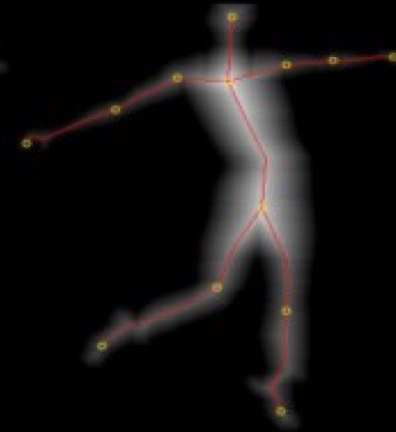
Skeleton extraction is essential for general shape representation. A typical skeletonization algorithm should obtain the ability to preserve original object’s topological and hierarchical properties. However, most of current methods are high memory cost, computationally intensive, and also require complex data structures. In this paper, we propose an efficient and accurate skeletonization method for the skeleton feature points extracted from human body based on silhouette images. First, the gradient of distance transform is used to detect critical points inside the foreground. Then, we converge and simplify critical points in order to generate the most important and elegant skeleton feature points. Finally, we present an algorithm which connects the skeleton feature points and estimates the position of skeleton joints.
Main reference:
J. Ding, Y. Wang and L. Yu, "Extraction of Human Body Skeleton Based on Silhouette Images," 2010 Second International Workshop on Education Technology and Computer Science, Wuhan, China, 2010, pp. 71-74, doi: 10.1109/ETCS.2010.241.
BibTeX:
@INPROCEEDINGS{5459597,
  author={Ding, Jianhao and Wang, Yigang and Yu, Lingyun},
  booktitle={2010 Second International Workshop on Education Technology and Computer Science},
  title={Extraction of Human Body Skeleton Based on Silhouette Images},
  year={2010},
  volume={1},
  number={},
  pages={71-74},
  keywords={Humans;Skeleton;Joints;Iterative algorithms;Euclidean distance;Data mining;Motion analysis;Image converters;Shape;Feature extraction;Feature Detection;Skeletonization;Joints estimation},
  doi={10.1109/ETCS.2010.241}}