Effect of Visual Cues on Pointing Tasks in Co-located Augmented Reality Symposium on Spatial User Interaction
Abstract:
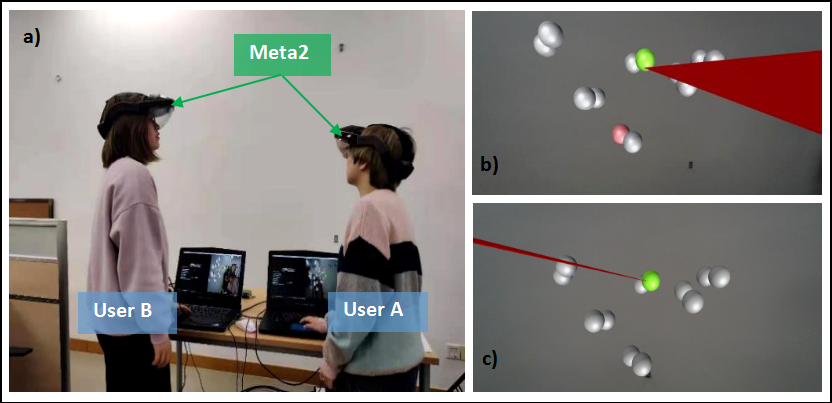
Visual cues are essential in computer-mediated communication. It is especially important when communication happens in a collaboration scenario that requires focusing several users’ attention on a specific object among other similar ones. This paper explores the effect of visual cues on pointing tasks in co-located Augmented Reality (AR) collaboration. A user study (N = 32, 16 pairs) was conducted to compare two types of visual cues: Pointing Line (PL) and Moving Track (MT). Both are head-based visual techniques. Through a series of collaborative pointing tasks on objects with different states (static and dynamic) and density levels (low, medium and high), the results showed that PL was better on task performance and usability, but MT was rated higher on social presence and user preference. Based on our results, some design implications are provided for pointing tasks in co-located AR collaboration.
Main reference:
Lei Chen, Yilin Liu, Yue Li, Lingyun Yu, BoYu Gao, Maurizio Caon, Yong Yue, and Hai-Ning Liang. 2021. Effect of Visual Cues on Pointing Tasks in Co-located Augmented Reality Collaboration. In Proceedings of the 2021 ACM Symposium on Spatial User Interaction (SUI '21). Association for Computing Machinery, New York, NY, USA, Article 12, 1–12. https://doi.org/10.1145/3485279.3485297
BibTeX:
@inproceedings{10.1145/3485279.3485297,
author = {Chen, Lei and Liu, Yilin and Li, Yue and Yu, Lingyun and Gao, BoYu and Caon, Maurizio and Yue, Yong and Liang, Hai-Ning},
title = {Effect of Visual Cues on Pointing Tasks in Co-located Augmented Reality Collaboration},
year = {2021},
isbn = {9781450390910},
publisher = {Association for Computing Machinery},
address = {New York, NY, USA},
url = {https://doi.org/10.1145/3485279.3485297},
doi = {10.1145/3485279.3485297},
abstract = {Visual cues are essential in computer-mediated communication. It is especially important when communication happens in a collaboration scenario that requires focusing several users’ attention on a specific object among other similar ones. This paper explores the effect of visual cues on pointing tasks in co-located Augmented Reality (AR) collaboration. A user study (N = 32, 16 pairs) was conducted to compare two types of visual cues: Pointing Line (PL) and Moving Track (MT). Both are head-based visual techniques. Through a series of collaborative pointing tasks on objects with different states (static and dynamic) and density levels (low, medium and high), the results showed that PL was better on task performance and usability, but MT was rated higher on social presence and user preference. Based on our results, some design implications are provided for pointing tasks in co-located AR collaboration.},
booktitle = {Proceedings of the 2021 ACM Symposium on Spatial User Interaction},
articleno = {12},
numpages = {12},
keywords = {Visual cues, Pointing Tasks, Co-located collaboration, Augmented Reality},
location = {Virtual Event, USA},
series = {SUI '21}
}