Charting Beyond Sight with DataStory: Sensory Substitution and Storytelling in Visual Literacy Education for Visually Impaired Children
Abstract:
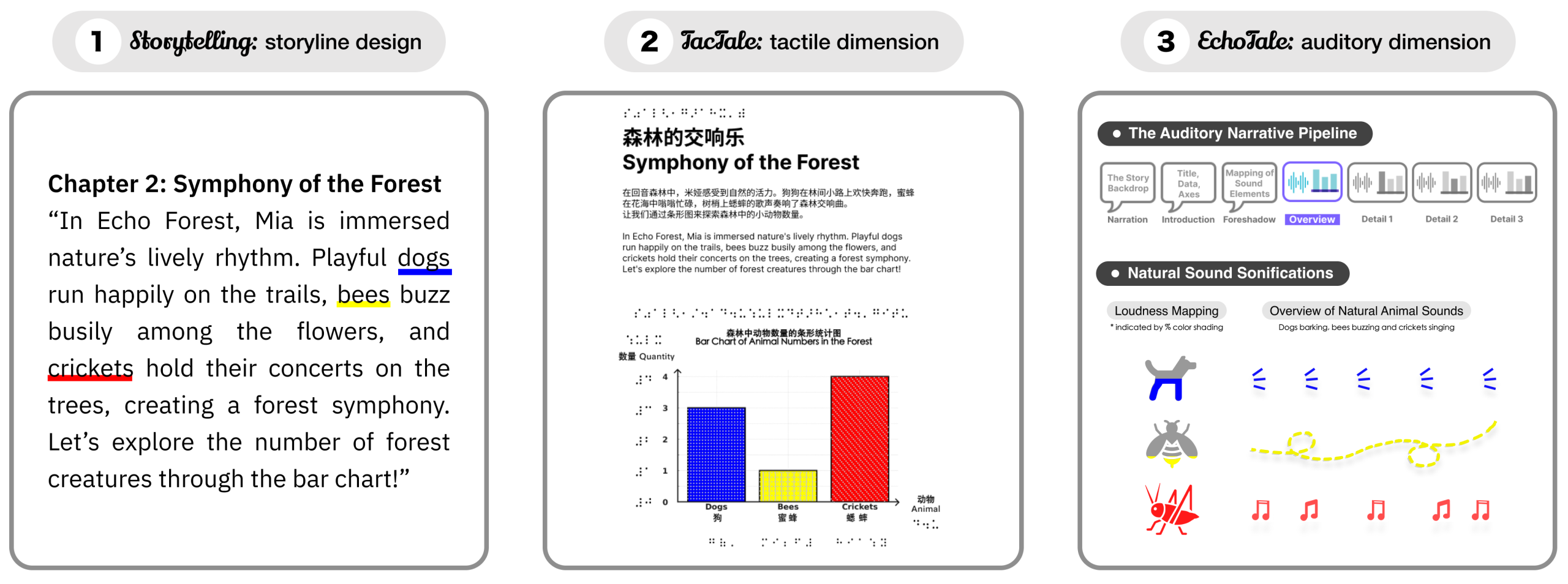
Visualizations transform raw data into accessible insights. However, they often exclude the visually impaired community. Despite tools like alt-texts and screen readers for translating visual information, visual literacy remains a fundamental barrier to interpreting visual data. Standard visual literacy education is less accessible to visually impaired learners. Our study explores visualization education through alternative sensory channels for visually impaired students. This work has three main contributions: examining educational practices for visually impaired students at a special education school; defining design requirements focused on sensory substitution; and developing a storytelling-based assistive learning prototype. The final design, DataStory, is a tactile storybook with embedded visualizations and sonified data narratives. To evaluate its feasibility, we conducted a pilot study with proxy students and a special education teacher. The paper concludes with a discussion on limitations and future directions in assistive visualization education, promoting further research into equitable educational tools for visually impaired children.
Main reference:
Shuqi He and Lingyun Yu. 2024. Charting Beyond Sight with DataStory: Sensory Substitution and Storytelling in Visual Literacy Education for Visually Impaired Children. In Extended Abstracts of the CHI Conference on Human Factors in Computing Systems (CHI EA '24). Association for Computing Machinery, New York, NY, USA, Article 73, 1–8. https://doi.org/10.1145/3613905.3650800
BibTeX:
@inproceedings{10.1145/3613905.3650800,
author = {He, Shuqi and Yu, Lingyun},
title = {Charting Beyond Sight with DataStory: Sensory Substitution and Storytelling in Visual Literacy Education for Visually Impaired Children},
year = {2024},
isbn = {9798400703317},
publisher = {Association for Computing Machinery},
address = {New York, NY, USA},
url = {https://doi.org/10.1145/3613905.3650800},
doi = {10.1145/3613905.3650800},
abstract = {Visualizations transform raw data into accessible insights. However, they often exclude the visually impaired community. Despite tools like alt-texts and screen readers for translating visual information, visual literacy remains a fundamental barrier to interpreting visual data. Standard visual literacy education is less accessible to visually impaired learners. Our study explores visualization education through alternative sensory channels for visually impaired students. This work has three main contributions: examining educational practices for visually impaired students at a special education school; defining design requirements focused on sensory substitution; and developing a storytelling-based assistive learning prototype. The final design, DataStory, is a tactile storybook with embedded visualizations and sonified data narratives. To evaluate its feasibility, we conducted a pilot study with proxy students and a special education teacher. The paper concludes with a discussion on limitations and future directions in assistive visualization education, promoting further research into equitable educational tools for visually impaired children.},
booktitle = {Extended Abstracts of the CHI Conference on Human Factors in Computing Systems},
articleno = {73},
numpages = {8},
keywords = {Assistive learning technologies, Sensory substitution, Storytelling, Visually impaired education},
location = {Honolulu, HI, USA},
series = {CHI EA '24}
}